
Random Access Memory (RAM) – Important Facts and Modern Applications
Introduction
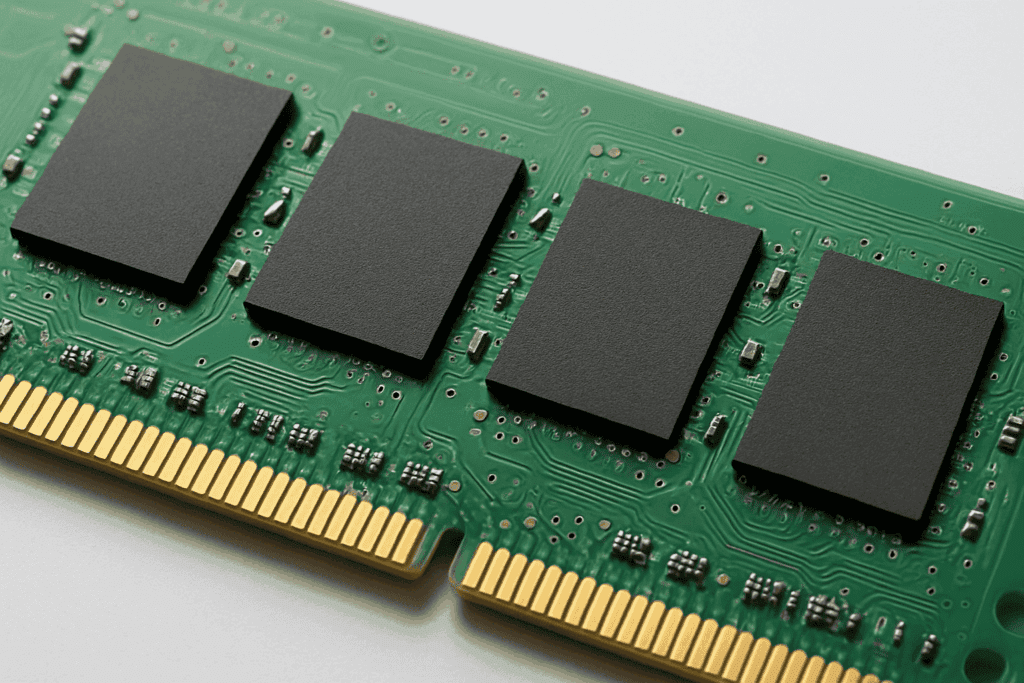
Random Access Memory (RAM) is a form of volatile computer memory that stores data temporarily while a system is running. It enables quick access to active information, making it an essential element of computer hardware. Unlike storage devices such as hard disk drives (HDDs) or solid-state drives (SSDs), data in system memory is erased when the power is turned off.
History
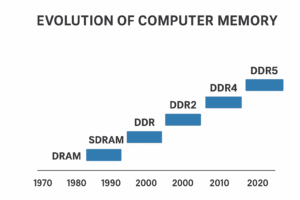
Early computers in the 1940s and 1950s used technologies such as mercury delay lines and magnetic-core memory. These early designs were bulky and limited in capacity. In 1970, Intel introduced the first commercially available dynamic memory chip, which revolutionized computing performance.
Since then, memory technology has advanced through multiple generations, from DRAM to DDR5. Each iteration brought improvements in speed, efficiency, and density, supporting the growth of personal computers, mobile devices, gaming consoles, and enterprise servers.
Definition and Function
Memory modules act as the short-term working area of a computer system. When an application launches, its instructions and data are transferred from permanent storage into RAM so the central processing unit (CPU) can retrieve them quickly. Because information can be accessed in any order (“random access”), performance is significantly faster than with sequential storage devices.
This temporary storage differs from read-only memory (ROM), which is permanent and not writable under normal use. Without sufficient memory, systems depend heavily on virtual memory from storage drives, which slows performance.
Types of Memory
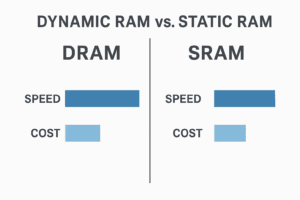
DRAM (Dynamic Random Access Memory)
-
Stores bits of data in capacitors.
-
Requires constant refreshing.
-
Common in most desktop and laptop computers.
SRAM (Static Random Access Memory)
-
Uses flip-flops to store data.
-
Faster but more expensive than DRAM.
-
Frequently used in CPU caches.
SDRAM (Synchronous DRAM)
-
Operates in sync with the system clock.
-
Provided the basis for DDR generations.
DDR (Double Data Rate)
-
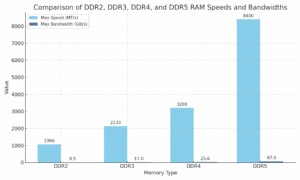
Includes DDR, DDR2, DDR3, DDR4, and DDR5.
-
Each generation boosts bandwidth, lowers power use, and improves efficiency.
-
DDR4 remains widely deployed, while DDR5 adoption is growing in high-performance PCs and servers.
Technical Specifications
Capacity
Measured in gigabytes (GB). Common allocations:
-
4GB → light computing
-
8GB → standard everyday use
-
16GB → gaming and multitasking
-
32GB+ → professional workloads
Speed and Latency
-
Speed is listed in MHz or MT/s (megatransfers per second).
-
Higher numbers provide faster data transfers.
-
Latency, measured in cycles, affects responsiveness.
Channels
-
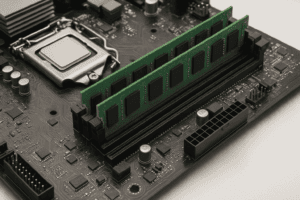
Single channel: one module.
-
Dual or quad channel: parallel operation increases throughput.
Applications
-
Personal Computers: Installed as DIMM modules in desktops or SO-DIMMs in laptops.
-
Mobile Devices: Smartphones and tablets use LPDDR (Low-Power DDR).
-
Servers and Workstations: Rely on large capacities and error-correcting code (ECC) to ensure stability.
-
Gaming Consoles: Specialized memory provides high-speed access for graphics rendering.
Comparison with Other Memory Types
-
System memory vs storage: One is temporary, the other permanent.
-
Memory vs cache: Cache is faster but smaller, integrated close to the CPU.
-
Physical vs virtual memory: When physical capacity is insufficient, the operating system allocates part of the storage drive as slower “virtual” memory.
Future Developments
-
DDR5: Doubles bandwidth compared to DDR4, increasingly common in new devices.
-
HBM (High Bandwidth Memory): Provides extreme throughput for GPUs and AI applications.
-
Persistent memory technologies: Solutions such as Intel Optane aim to retain data even after shutdown.
-
3D stacking: Emerging techniques may significantly increase density and efficiency.
-
Researchers are also exploring low-power and hybrid solutions, which may combine the best features of RAM and storage to improve both speed and energy efficiency.
See Also
References
-
Jacob, B., Ng, S., & Wang, D. (2010). Memory Systems: Cache, DRAM, Disk. Morgan Kaufmann.
-
Hennessy, J. L., & Patterson, D. A. (2017). Computer Architecture: A Quantitative Approach. Morgan Kaufmann.
-
Intel Corporation. (2022). DDR5 Memory Technology Overview.
External Link
For practical computer hardware guides and services, visit AllTechSolutions.