
Introduction
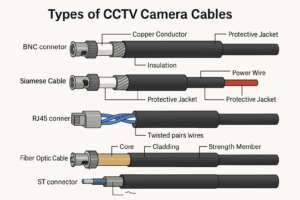
A CCTV camera cable serves as the critical connection between surveillance cameras and recording or monitoring devices. It ensures the transmission of both video signals and, in many cases, power supply, forming the backbone of any reliable security system. The type, quality, and installation of these cables play a major role in determining the overall performance and clarity of a CCTV setup.
Types of CCTV Camera Cables
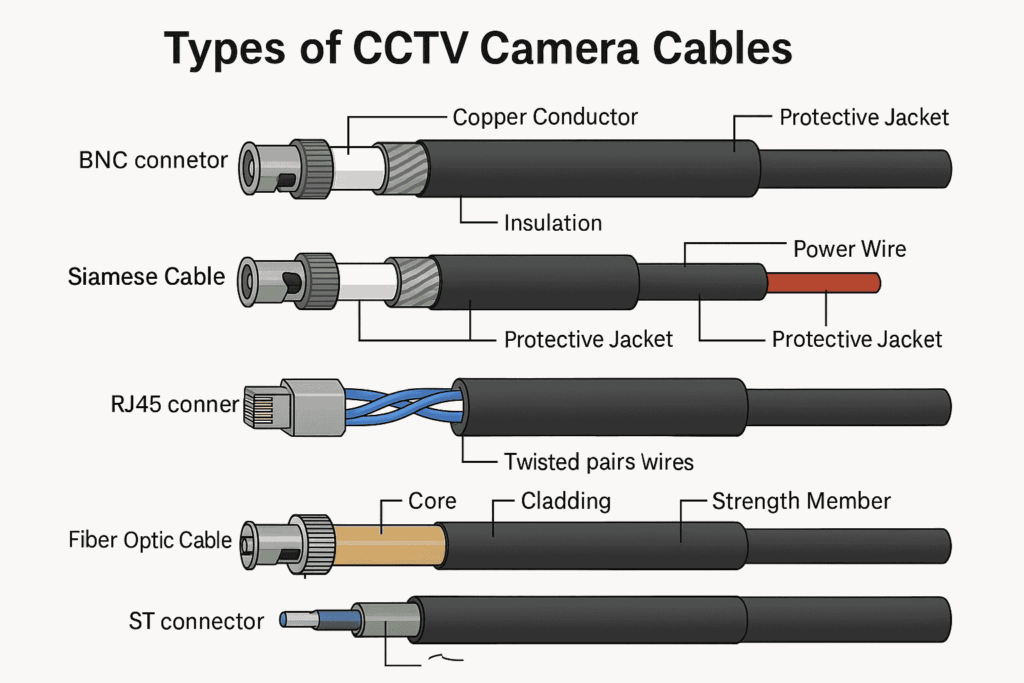
Several types of cables are used in closed-circuit television (CCTV) systems, depending on signal requirements, distance, and installation environments.
1. Coaxial Cable
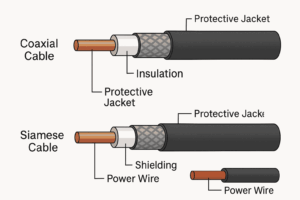
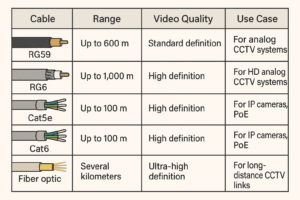
A coaxial CCTV cable is one of the most traditional and widely used cables in analog CCTV systems. It carries video signals through a central copper conductor, surrounded by insulation and shielding layers that reduce signal interference.
-
RG59: Ideal for short-distance analog connections (up to 200–300 meters).
-
RG6: Suitable for longer distances due to thicker insulation and lower signal loss.
-
RG11: Used for extended cable runs exceeding 500 meters.
2. Siamese Cable
A Siamese cable for CCTV combines both video and power lines in a single jacket. This makes installation easier and reduces clutter in multi-camera systems, especially when power sources are nearby.
This type is commonly used for analog CCTV cameras that require both 12V DC power and video transmission.
3. Network (Ethernet) Cable
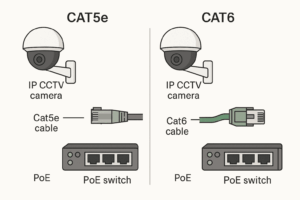
For IP-based surveillance, an Ethernet cable for IP cameras, like Cat5e or Cat6, enables Power over Ethernet (PoE). This simplifies cabling by transmitting both data and power through a single connection.
-
Cat5e: Supports data speeds up to 1 Gbps.
-
Cat6: Offers higher bandwidth and improved noise resistance, ideal for 4K IP cameras.
4. Fiber Optic Cable
A fiber optic CCTV cable offers unmatched data transmission speed and long-distance performance. It’s perfect for large commercial complexes, city surveillance, and high-resolution camera networks.
Cable Connectors and Accessories
CCTV systems use various connectors to attach cables securely to cameras, DVRs, and NVRs.
-
BNC Connectors: Standard for coaxial cables, providing a secure bayonet-style connection.
-
RJ45 Connectors: Used for Ethernet cables in IP camera systems.
-
DC Connectors: Supply power to cameras through power cables.
Additional accessories such as baluns, splitters, and PoE injectors enhance flexibility and expand connection options.
Installation and Best Practices
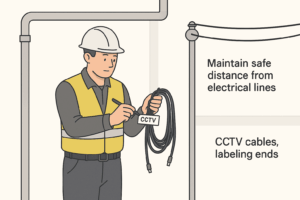
Proper cable installation is crucial to maintaining signal quality and avoiding interference.
-
Avoid running cables parallel to high-voltage lines.
-
Use shielded cables in environments with strong electrical noise.
-
Label both ends of each cable for easy troubleshooting.
-
Secure cables with clips or conduits to prevent physical damage.
-
For outdoor setups, use weatherproof and UV-resistant cables.
Common Issues and Troubleshooting
-
Signal loss or video distortion: Often due to excessive cable length or poor-quality connectors.
-
Power drop: Caused by voltage loss in long cable runs. Using a thicker gauge cable can help.
-
Interference: Common when unshielded cables are placed near electrical lines.
-
Connectivity issues: Usually linked to damaged connectors or improper crimping.
Choosing the Right CCTV Camera Cable
Selecting the proper cable depends on several factors:
| Criteria | Recommended Cable Type |
|---|---|
| Analog cameras (short distance) | RG59 Siamese Cable |
| Analog cameras (long distance) | RG6 or RG11 |
| IP cameras | Cat5e or Cat6 Ethernet Cable |
| Large-scale, long-distance systems | Fiber Optic Cable |
| Outdoor environments | Weatherproof Siamese or Cat6 Outdoor Cable |
The Role of CCTV Camera Cables in Modern Security
As security technology evolves, CCTV camera cables continue to play a vital role in system stability and data integrity. Even with the advent of wireless systems, wired connections remain the most reliable option for professional and commercial surveillance networks due to their consistent signal quality and reduced latency.
See Also
References
-
Electronic Security Association – CCTV System Components Overview
-
Security Industry Association – Cable Standards for Video Surveillance Systems
-
IEEE Standards for Ethernet (802.3af, 802.3at, 802.3bt)